
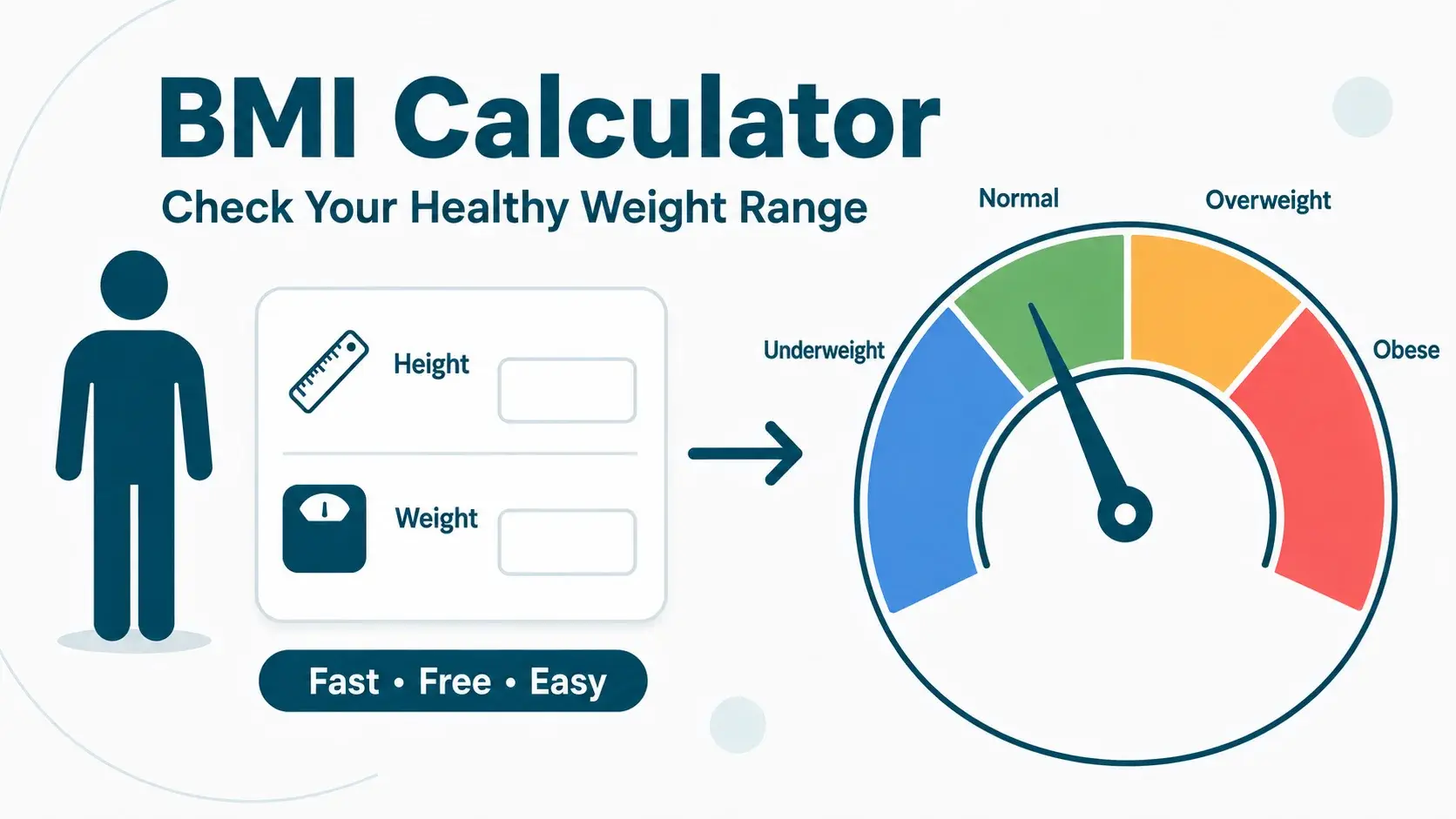
Body Mass Index is one of the most commonly used screening numbers in healthcare, but most people have never actually calculated their own — they’ve just seen the number handed to them at a doctor’s visit. ToolFlexy’s free BMI calculator gives you that number instantly, in either metric or imperial units, along with the weight category it falls into and what a healthy range looks like for your height.
This guide covers exactly how BMI is calculated, what each category actually means, and where BMI falls short as a health measurement — so you’re not just reading a number, you understand what it does and doesn’t tell you.
What Is BMI and Why Does It Matter?
Body Mass Index (BMI) is a screening measurement that estimates whether your weight is healthy relative to your height. It’s calculated from just two numbers — height and weight — which makes it fast to compute, but also means it can’t account for things like muscle mass or body composition.
Doctors, insurers, and public health organizations use BMI as a quick, low-cost starting point for identifying potential weight-related health risks, not as a full diagnosis. According to the CDC’s guidance on adult BMI, it correlates with body fat for most people, but should be considered alongside other health measurements, not in isolation.
How to Use the Free BMI Calculator in 3 Steps
ToolFlexy’s calculator works the same way whether you think in metric or imperial units.
Step 1: Choose Your Unit System
Toggle between metric (centimeters and kilograms) and imperial (feet/inches and pounds), depending on which you’re more comfortable with.
Step 2: Enter Your Height and Weight
Type in your current height and weight. Age and gender fields are optional and aren’t required to get a BMI result.
Step 3: Get Your BMI and Category Instantly
Your BMI score, weight category, and a healthy weight range for your height appear immediately, with no calculation needed on your end.
The BMI Formula: How It’s Actually Calculated
BMI is calculated by dividing your weight by the square of your height. The formula differs slightly depending on which unit system you’re using.
- Metric formula: BMI = weight (kg) ÷ height (m)². For example, someone weighing 70 kg at 1.75 m tall has a BMI of 70 ÷ (1.75 × 1.75) = 22.9.
- Imperial formula: BMI = (weight (lbs) ÷ height (in)²) × 703. For example, someone weighing 154 lbs at 69 inches tall has a BMI of (154 ÷ 4,761) × 703 ≈ 22.7.
You don’t need to do this math yourself — the free BMI calculator handles the conversion and calculation instantly, regardless of which unit system you enter.
What Your BMI Result Means
BMI results fall into four standard categories used across most medical and public health guidelines.
| BMI Range | Category | General Meaning |
|---|---|---|
| Below 18.5 | Underweight | May indicate insufficient nutrition or an underlying health issue. |
| 18.5 – 24.9 | Normal weight | Generally associated with lower risk of weight-related health conditions. |
| 25 – 29.9 | Overweight | May increase risk of certain health conditions over time. |
| 30 and above | Obese | Associated with higher risk of conditions like type 2 diabetes and heart disease. |
These ranges are the same ones used by major health bodies, but they’re a starting point for a conversation with a healthcare provider, not a standalone diagnosis.
Key Features of This Free BMI Calculator
- Dual Unit Support: Switch freely between metric and imperial without doing any manual conversion.
- Instant Categorization: Your BMI is automatically sorted into underweight, normal, overweight, or obese.
- Healthy Weight Range: See a target weight range for your specific height, not just a single number.
- No Data Stored: Your height, weight, and results aren’t saved or tied to an account.
Why BMI Isn’t the Full Picture
BMI is a useful general screening tool, but it doesn’t account for muscle mass, bone density, or body composition. Two people can share the same height, weight, and BMI, and have very different body compositions — a muscular athlete, for example, can register as “overweight” on a BMI scale despite having low body fat.
This is exactly why doctors treat BMI as one data point among several — alongside waist circumference, body fat percentage, activity level, and overall health history — rather than a definitive measure of fitness or health on its own.
BMI vs. Other Health Measurements
BMI is popular because it’s fast and free to calculate, but it’s not the only screening number worth knowing. Understanding how it compares helps explain why doctors rarely rely on it alone.
- Waist circumference: Measures fat concentrated around the abdomen specifically, which research links more directly to cardiovascular risk than overall body weight.
- Body fat percentage: Measures the actual proportion of fat versus lean mass, which BMI can’t distinguish at all — this is why athletes often see misleadingly high BMI results.
- Waist-to-hip ratio: Compares waist and hip measurements to assess fat distribution patterns, another factor BMI doesn’t capture.
- Basal metabolic rate (BMR): Estimates how many calories your body burns at rest, useful for nutrition planning in a way BMI alone doesn’t address.
None of these replace BMI outright — they each add context BMI is missing. A free BMI calculator remains a reasonable first step precisely because it takes seconds and needs no special equipment, while the other measurements typically require tape measures, calipers, or lab equipment to get an accurate reading.
Common Reasons People Check Their BMI
- Routine health tracking: Monitoring general trends in weight relative to height over time.
- Before a doctor’s visit: Having the number ready ahead of an appointment where it’s likely to come up.
- Fitness and nutrition planning: Using BMI as one input alongside goals set with a trainer or nutritionist.
- Insurance and employer wellness programs: Some programs use BMI as part of broader health screening requirements.
Explore More Free Calculators on ToolFlexy
BMI is often just one number people want alongside others. A few tools that pair well with it:
- Calculate your exact age if you need it for a health form or appointment.
- Use the percentage calculator for tracking weight change over time.
- Convert between units if you need a quick height or weight conversion outside the calculator.
Conclusion
BMI is a fast, simple screening number, and the free BMI calculator gets you there in seconds — but the number is only useful once you understand what it means and where its limits are. Use it as a starting point, not a final verdict, and pair it with a conversation with a healthcare provider for a complete picture of your health.